
Data Centers
Potential staff water, emergency potable reserves, cleaning, landscaping, humidification and selected facility-support applications after engineering and treatment review.
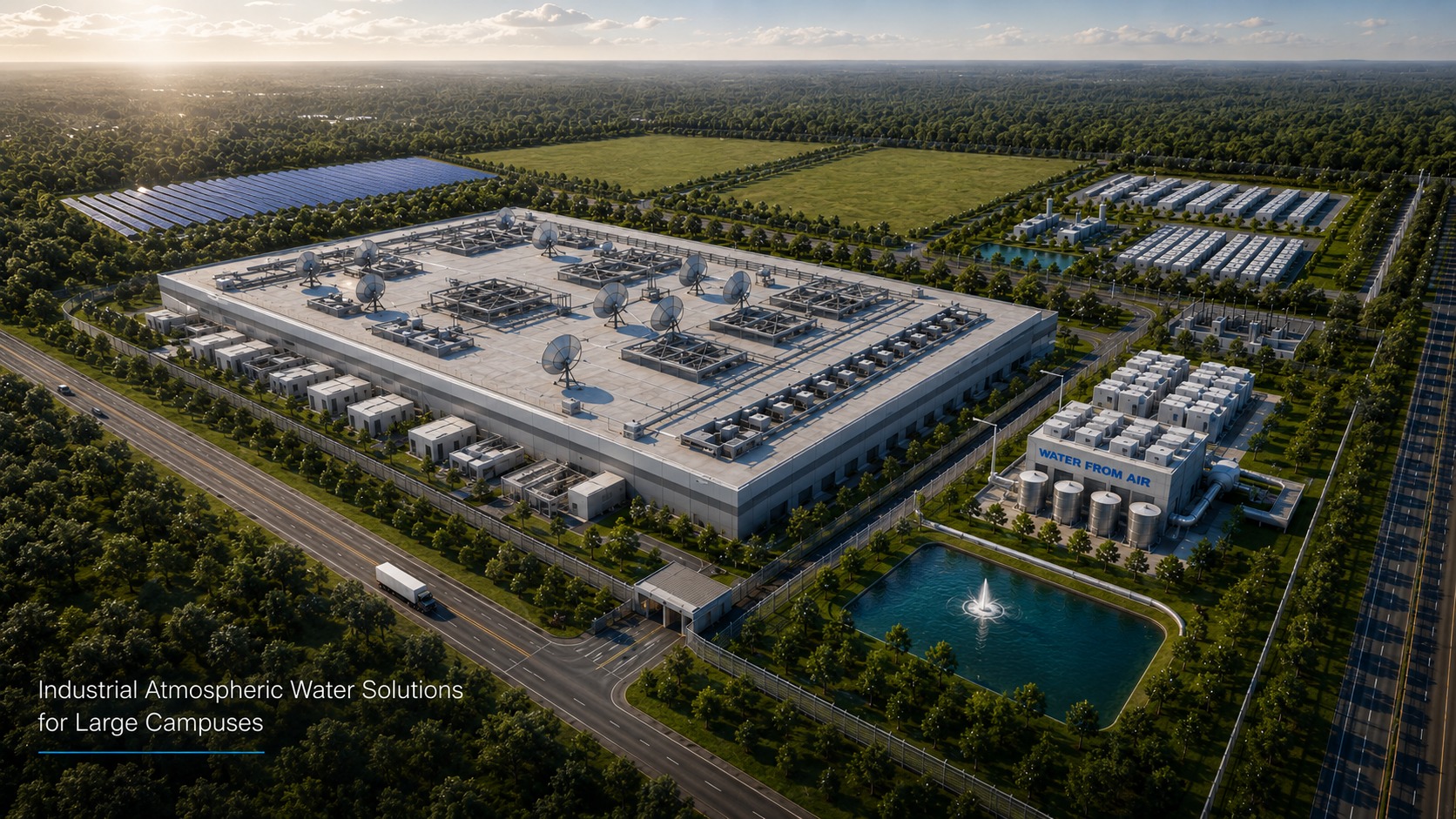
A high-capacity atmospheric water platform for data centers, hospitals, institutional campuses, large office buildings, hospitality properties and other facilities that require project-specific water planning.
Preliminary manufacturer information: final production, equipment configuration, water uses and project suitability require written confirmation and engineering review.
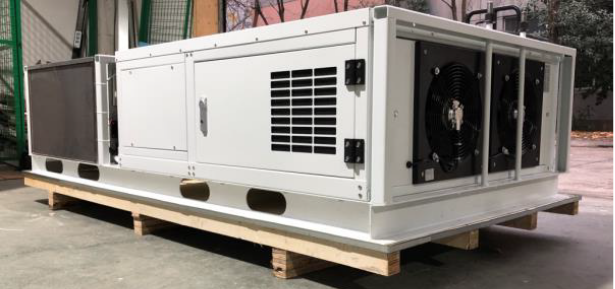
The quoted industrial platform combines high-capacity atmospheric condensation with a multi-stage treatment configuration, programmable controls and project-specific storage and distribution planning.
| Model | AWG-5000L-38 |
|---|---|
| Quoted production* | 5,100 L/day at 30 C / 80% RH |
| Alternate quoted production* | 3,000 L/day at 27 C / 60% RH |
| Rated input power | 38 kW |
| Electrical supply | 380V, 3-phase, 50/60 Hz |
| Quoted operating range | 15 C-43 C and 25%-95% RH |
| Controls | PLC and touch-screen interface |
| Treatment reference | PPF, GAC, RO and LED-UV |
*Actual output is highly dependent on temperature, relative humidity, airflow, operating hours, installation conditions and equipment condition.
Each application requires a defined water-use plan, independent water-quality verification and appropriate system integration.
Potential staff water, emergency potable reserves, cleaning, landscaping, humidification and selected facility-support applications after engineering and treatment review.
Potential resilience and facility-support applications, subject to clinical water standards, infection-control requirements, testing and local approvals.
Potential distributed drinking-water, staff, landscaping and emergency-reserve uses across multi-building properties.
Potential employee hydration, cafeterias, emergency reserve and approved facility-support uses.
Potential guest, staff and selected operational water uses, subject to demand, storage, sanitation and local requirements.
Supplemental on-site production where delivered water, logistics or storage create significant operational challenges.
Potable reserve, staff use, cleaning, landscaping, humidification or another clearly defined application.
Temperature, relative humidity, seasonal variation, airflow and expected operating schedule.
Available three-phase power, location, ventilation, drainage, access, structural support and noise considerations.
Finished-water specifications, storage volume, recirculation, sanitation, distribution and testing requirements.
Final project cost can vary materially based on equipment quantity, destination, freight, duties, taxes, electrical work, storage, treatment, installation, commissioning, testing, permits, training and service coverage.
A written proposal should identify responsibilities, exclusions, performance assumptions, environmental conditions, warranty terms and the process for confirming final water quality.
EcoBlue Water USA is developing industrial, institutional, commercial, dealer and distribution relationships across the United States and Caribbean.
Caribbean projects should address freight, customs, taxes, electrical standards, installation logistics, replacement supplies, commissioning and local service coverage early in the planning process.
Discuss your facility and intended water useInclude the country or island, facility type, intended water uses, required daily volume, available power and project timeline.
Preliminary manufacturer data quotes approximately 5,100 liters per day at 30 C and 80% relative humidity, and approximately 3,000 liters per day at 27 C and 60% relative humidity. Actual production varies substantially with site conditions.
Potential applications include data centers, hospitals, large offices, institutional campuses, hospitality properties and remote facilities, subject to engineering and regulatory review.
Yes. Climate, electrical, storage, treatment, water-quality, maintenance, integration and regulatory requirements should be reviewed before purchase or installation.
No. Potable, clinical, process, cooling, humidification and cleaning uses may have different treatment and quality requirements. The intended uses must be defined and approved.
Potentially. Multiple-unit deployments require planning for electrical capacity, controls, treatment, storage, distribution, redundancy, maintenance and realistic climate-adjusted production.
Final pricing depends on equipment quantity, destination, freight, duties, taxes, electrical configuration, treatment and storage design, installation, commissioning and service coverage.